The generic Mega Mushy is easy to tie and gets my tick as the #1 kingfish fly... my #1 anyhow. It flows and has nice flash in the water.
Tuesday, September 25, 2012
NE =
The prevailing NE wind at this time of year signals warm water arriving and with it comes a host of fish to do fishy things; anchovies and pilchards run and spawn as do snapper and post spawning & juvenile kingfish chase the bait and so it goes. The charter guys are reporting surges of male snapper schools, not super hot workups just yet but encouraging all the same. We are probably only a few weeks from kingis turning up on the marker buoys in the harbour, so time to get ready for them again. I can't sit and tie lots of flies anymore so just roll 2 or 3 off the vice at a time. Noticed I'm running short of SL12s in 4/0 so will have to order more.
The generic Mega Mushy is easy to tie and gets my tick as the #1 kingfish fly... my #1 anyhow. It flows and has nice flash in the water.
Monday, September 24, 2012
Goose decoy maintenance
I've seen some pretty hoary goose decoys out in the field, and there's no escaping the fact that they can get pretty bounced around in the truck/trailer/ute; and that takes a toll. After last weekend's hunt where it was wet, I didn't have much of a chance to get everything nice and dry, maybe only 90%. My dekes live in slotted bags, and most of the time they have socks on the flocked heads but given that the bags/socks got soaked last time out, I didn't re-sock them.
Got them out this morning for a clean-up.
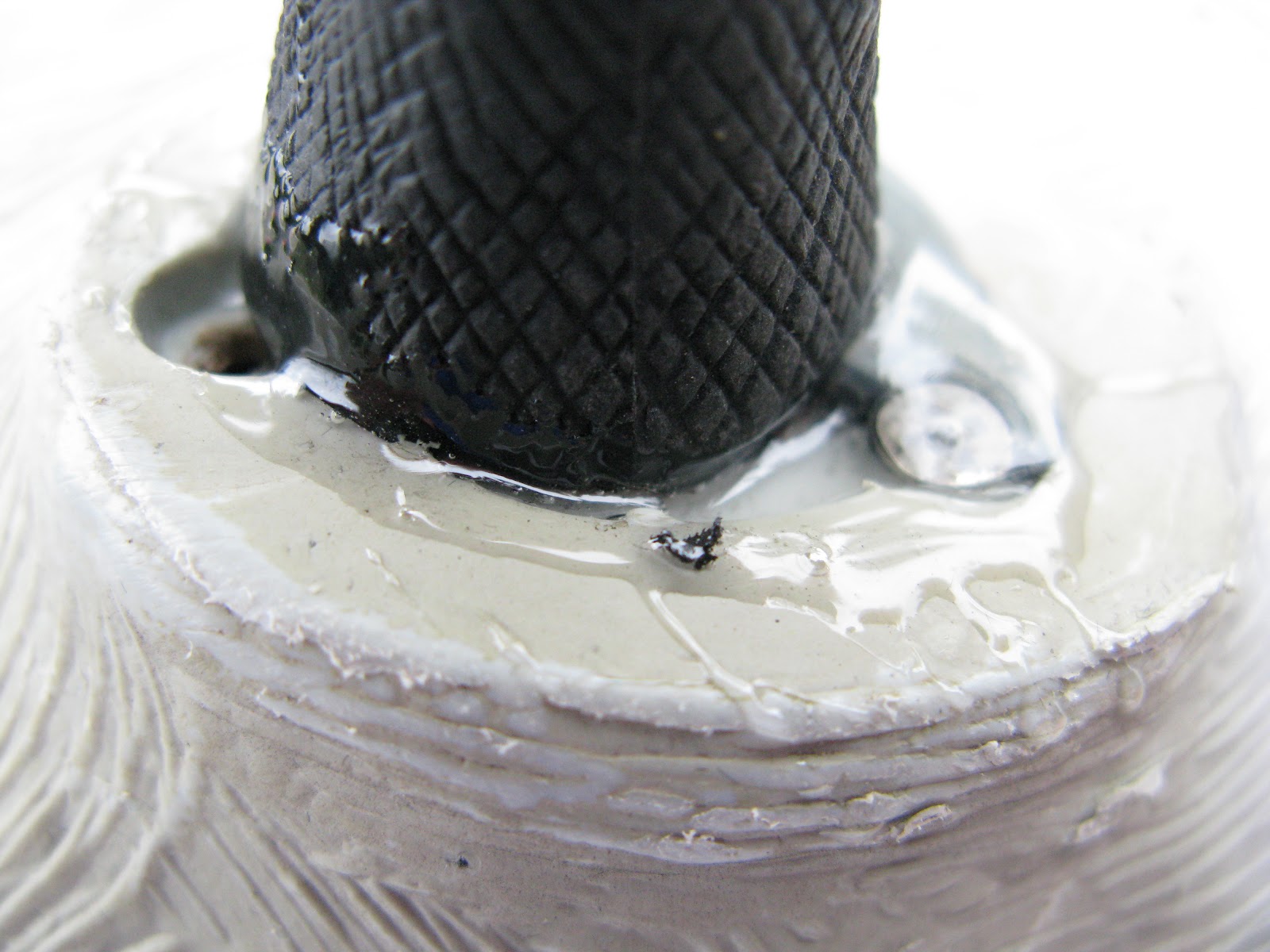
There are 2 brands of full bodies in my mix, GHGs and FAs. If I were going to buy again, I'd avoid the FAs like the plague. Just taking one of the sentry geese out this morning, I broke its leg mount. This piece is critical to their upright geese versions, as the base mounting ring slides up inside the decoy's leg. So at the moment I have some 2 pot going to work, hopefully the repair is smooth.
Anyhow, got the bags airing and hopefully after the remedial work the FA sentry can go back into the field.
I have my eye on some Higdon Alpha Wobblers to stack out the spread a bit .. maybe some FAs will appear on auction websites soon.
Got them out this morning for a clean-up.
Stupid leg arrangement
|
| 2 pot mix... hopefully it works |
Secondly, the paint quality is awful. The FAs are chipped to crap already. In fact, they came out of the box with paint rubbed off.
| Candidate for flocking? |
Bad chipping
|
| I recommend Avery's full body slotted bags, tough & durable |
I have my eye on some Higdon Alpha Wobblers to stack out the spread a bit .. maybe some FAs will appear on auction websites soon.
![]() |
| All snug in their bag |
Sunday, September 23, 2012
Flocking your dekes
When Tim and I hunted with Paul earlier this year, we were introduced to his home rolled fully flocked mallard decoys. Now it's definitely a leap of faith to take to your decoys with adhesive and flocking and paint and god knows what else, because good decoys aint cheap.
Rather than seek advice, I just thought "yeah I'm into that" and set off at a million miles per hour. First, I found a couple of Avery full body hens from the batch that turned a lovely shade of pink/peach :)...
Then I looked around for flocking, and found some locally sourced stuff that was coarser than normal flocking. Then I used a plastic based spray paint as adhesive; and shook the flocking on.
Next you need to leave your flocking to dry for at least 24 hours. Very important. And don't do what I did - touch it and knock patches off... doh. Around about there I had a giant epiphany or "DOH!" when I spoke with Paul about how to get the colour mix and he told me he'd ordered flocking in the right base colours.
So I had to figure out some greylard colour schemes which I did, and air brush the dekes.
Took me a few weeks to get around to it.
Just got to do some colouration work on the grey version, green beak and green-grey legs. From 20m they look pretty real and anything that close should be dead before it realises its mistake....
Rather than seek advice, I just thought "yeah I'm into that" and set off at a million miles per hour. First, I found a couple of Avery full body hens from the batch that turned a lovely shade of pink/peach :)...
| You need to catch loose flocking as it is applied - I used a small fish bin |
| Flocking |
So I had to figure out some greylard colour schemes which I did, and air brush the dekes.
Took me a few weeks to get around to it.
| Grey duck |
| Mallard hen |
Saturday, September 22, 2012
On Killerweed....
Last week Matt told me that we'd be hunting in pretty much crap pasture covered in all sorts of rushes, weeds and other assorted crap. In my mind's eye I pictured brown top and rushes, so thought that rather than grassing the layout, I'd use the "Winter Wheat" Avery Killerweed that I had lying around.
Here are my impressions:
I might have a shot at dying it a bit greener - could be a winner after that. I probably wouldn't go out of my way to buy it again.
Here are my impressions:
- One box is supposed to cover a layout. Uh-uh, no way. 2 boxes will almost do the job - I was into the 3rd box before I was happy with coverage.
- The texture is quite good and disguises the blind well enough
- Its a damn sight lighter than grass to carry...
- Even so, you can't ditch it at the end of the hunt so carrying it out again is unavoidable
- The colours weren't quite right, a bit too much yellow, but that's my fault for assuming we'd be on brown top and the actual hunting took place in green grass with rushes
- Next time I'll use god's own green grass.
- There are never any shortcuts that work as well as the real thing.
Friday, September 21, 2012
Tuesday, September 18, 2012
Goose hunt video
Matt makes another video - highlights quite nicely how the geese came in from all over, not just where we wanted them...
Sunday, September 16, 2012
Spring geese
Quick report - arrived at 03.45 at nominated spot. Matt, Tony & Derryn were running slightly late. When they arrived we pulled in and set about carrying our gear "250 metres" to the X where the geese had been. Matt can jam his 250 metres up his butt --- (said fondly. No, I'm fond of Matt, not his butt) the round trip was easily a km (later GPS'd at 1.3km). I should have left a bag of dekes in the car but decided to take 3 bags of full bodies, my blind bag crammed with unnecessary junk, my layout and of course my gun. Being that it was raining I was clad in over trousers and heavy jacket. 2 trips out were required.... then we set about trying to find where Matt & Tony had scouted the birds. We got set up and as usual in the dark the decoy set is a bit of a lottery but we got it pretty spot on. As the light came up the first birds began to move, mostly in pairs and several got up from a creek near by. By mid morning we had a few down and then they started coming in regularly. The weather improved dramatically, with sun appearing over head and the temperature rising. We had quite an array of opportunities, not the usual in the face decoying birds so some interesting shots were taken. By 10 am it was all quiet, and with 2 dozen birds down we knew we had a hard job ahead.... after some obligatory shots we began to bring in the decoys... and then the hike out began.
25 birds @ 4-5kg each. Shit. All the decoys. Shit. It was a slog. A real slog through basically bog. Shit. But man we were happy boys by the time we returned to the trucks. Then off up to Matt's place to clean the birds, a good drive home and now I'm idly watching my wet weather gear drying. Thanks lads, beaut hunt.
| Smile now boys... you'll be grimacing soon! |
25 birds @ 4-5kg each. Shit. All the decoys. Shit. It was a slog. A real slog through basically bog. Shit. But man we were happy boys by the time we returned to the trucks. Then off up to Matt's place to clean the birds, a good drive home and now I'm idly watching my wet weather gear drying. Thanks lads, beaut hunt.
| Tony & Matt, smiling again.. post grimace |
Saturday, September 15, 2012
Moron (more on) Taimen.... *sigh*
'Scuse the stupid pun. Taimen information keeps on pouring in... retaining it will be difficult. What I'm seeing here is quite a distinct pattern of similarities to fishing in NZ in the Autumn - lower water, cool or cold nights, mostly warm days. So gear-wise its not going to be too much to prepare for I think... especially as we'll not be travelling with fishing tackle (supplied by outfitter - but I'll damn well be making sure its the good sh*t or I will take my own).
I do have a couple of gear items that need upgrading. I'll be in the market for an outer garment to replace my current rain jacket.. No matter what, I'm determined to not be wet and cold, as that quickly can detract from the fun of a trip. Lucky we live in a land where living outside is pretty much an easy proposition - so there are a number of really good local manufacturers. Our weather can change in minutes - one time when I was in the South Island the temperature dropped an alarming 12 degrees in 20 minutes... that time I was in Christchurch so not a drama but one could easily have set out up a river on a pleasant hot day and got caught out.
I don't think that with Mongolia being so central within a continent that rapid weather changes will be as prevalent as here, but I damned if I wont be ready for it.
2:45 am
The not quite far northern contingent have tracked down some pesky geese being pesky on a farmer's paddocks.
Dark moon - check
Geese located - check
Weather conditions blustery - check
Decoys ready - check
Gun cleaned & checked - check
50 gram #2 lead shells ready - check
Thermos out and ready - check
Batteries in headlamp strong - check
Camera powered up - check
With the daylight hours extending I'm not going to get away with sleeping in until 3.30 am, so its going to be 2.45...... no beers during the rugby test match this evening I think.
Thursday, September 13, 2012
Researching, as you do....
Been trawling around the 'net as you do, mainly looking for fly patterns to try on Mr. Taimen next year. Found this site... where they talk about chopping up your prized catch and eating it! Really???
I mean these things are endangered. Trust me, I love catching and eating fish and am no wowser but somehow the idea of travelling vast distances to catch a rare-ish fish only to smack your catch on the head and roast it on a spit... well.
This passage got me wondering:
"What they eat and when
Cannibalistic is the word best used to describe the diet of the Mongolian Taimen. The actual term is piscivorous, for all you smart guys/girls out there. All it really means is that they mainly eat other fish. But here’s a surprise for y’all. They are known to hunt waterfowl (ducks, geese, etc.) as well as terrestrial rodents that wander into the water.
Taimen eat like all other salmon-like swimmers; opportunistically. When food becomes available, they become hungry, like the average human teen-ager."
Now I would love nothing more than to hunt ducks or geese since I'm going all that way, I wonder what's available up there? More digging to do....
Tuesday, September 11, 2012
Andy, on Mongolia
What a bonus! My friend Andy and his wife spent time in Mongolia a couple of years back. So he has been able to offer some advice. Some of it has been mint, so I'm sure he'll be happy if I share.
(Thin skinned folk from Huntly should switch off round about now. Or, if folks from Huntly choose to stay, consider this an insider joke. Andy's brother's wife is from Huntly...)
Snuffit: Here we go (sorry)
Andy: Don’t be
Snuffit: Did you take USD?
Andy: Yes, lots of it – but they had banks/ATMs that worked with our UK cards easily enough to get local and then change to USD.
Snuffit: Do they accept credit cards?
Andy: In some places.
Snuffit:What time of year were you there?
Andy: July / August
Snuffit: Would you recommend backpack or some other type of luggage? (thinking duffle)
Andy: Def backpack, don’t know how far you’ll be lugging things.
Snuffit: Is UB modern/decrepit/like Huntly?
Andy: A real mix, not like Huntly. Huntly is all decrepit, UB is probably 3/5 decrepit.
Snuffit: How far around the country did you guys go?
Andy: We were on the road for 5 days in Mongolia. Looking at our route on the map showed we covered and incredibly small part of the country but it was 5 days hard travel.
Snuffit: How did you travel?
Andy: By train in and out and by “Russian jeep” in Mongolia. Russian jeep is like an overgrown combi wagon. About as comfortable as travelling on a spade towed behind a herd of goats.
Snuffit: Are the locals friendly/mean/aggro/like people from Huntly?
Andy: Like anywhere in the world. A mix but mostly nice. We rocked up to a group or Gers (round yak tents) and asked if we could stay. The whole family moved out into the cooking tent to let us have the big one for the night. It was awesome.
Snuffit: More to come...
Andy: Bring it on.
Later, as perhaps an afterthought to stop me hiring a "Russian jeep" and doing it myself, Andy offered this...
"Just thinking about Mongolia. Outside of UB, it is total wild west. Shanty towns in the middle of nowhere, dogs and pigs running free, most people living a nomadic life, huge grassy valleys and wooded mountains – with NO ONE anywhere in sight. Most of the “roads” are just tracks across the grass that move as one gets cut up, muddy etc. and another becomes more friendly. The ‘roads marked on google maps for example are just an idea of where you could drive and not where you should… see screenshot below…"
Adventure Time!!!!
Sunday, September 9, 2012
Auckland - Narita - Ulaanbaatar..... Moron
Yup, Moron really is a place. A place in Mongolia. A place on the way to where stuff like this lives...
Roll on next September.... at last, something seriously cool to do in the lay month. TT, his wife Nicki and a couple of us hanger-on types are going to spend 6 days rafting down a remote river starting 30km from the Russian border.
Bucket list material! The stuff dreams are made of. Can September 2013 come fast enough?
Monday, September 3, 2012
Spring cleaning
Normally September heralds a bit of a lull; game birds are over, trout season is a month away... so far the snapper fishing seems patchy; however we are in the grips of a (dreaded) north easterly which has brought warmth, and rain, and no doubt will help the warmer water reach our shores which in turn will trigger snapper into spawning. Right now, schools of bait fish are still offshore accompanied by hunting dolphins and gannets and some reports of good fishing on plastics and slow jigs are beginning to come in.
Being weather-bound, I had a bunch of maintenance tasks to get through.
First, my old Tibor Gulfstream had been drag-slipping somewhat. No matter how tight I had screwed in the drag knob last time out the drag eased and slipped. Not great with a kingi rampaging on the other end.... luckily (?) I hadn't hooked anything large enough to do the rampaging, but still. These things are a cruise to service, simple draw-bar design makes it a cinch, the only gotcha is to watch out for the A/R springs but I give them a good grease coating so they don't wander off easily (I once spent a couple of hours searching around for an Abel A/R spring that lept across the room... not fun). Actually the Tibors come with spare springs tucked away in a wee orifice, which is good thinking. Once apart I checked the drag plate, cleaned it, gave it a once over quick touch up with fine sand paper and cleaned again. Once re-assembled it was restored to it's full drag powers, so I set it up on the #12 and tested the drag over a pulley and lifted 7kg easily enough on a pretty flat rod angle. The drag was smooth as a baby's bum.
Then I noticed that the loop-to-loop on the reel end of the #12 floater was looking worse for wear (not sure why as it has only been through the guides once that I can remember) so I replaced that.
Made sure all the fly rods had survived their winter neglect ok and they had.
Onto the other gear. Re-spooled the 6kg spin reel with new braid. Actually used some 4.5kg Gortex stuff and got 220m on the spool, pretty impressive on a 4000 sized reel. Checked guides for cracking and then checked the reels. The old SL30sh Daiwa needed a new bearing so dropped that into Hunts. And, as you do, had a good chin-wag with Ian and Roger. Good guys and supporting your local is important.
Back home it was time to shake down the boat. First thing I noticed was that some dick-wad had nicked my Warrant of Fitness sticker. Secondly, the number plate light was out of action. Took the motor cover off and checked for corrosion, but all was good. On with the ear-muffs and she started pretty much straight away, very encouraging. Out with the drills etc to install some Railblaza stuff that Tim had got for me. I like the low profile star port system, anything to avoid line catching when fly fishing. JBFC sat in the boat offering encouragement as I installed 4 new rod holders. Then vacuumed up the ali filings. Boat almost done, still need to replace the plate lamp and get a warrant replacement.
What I didn't anticipate though, with thoughts of fish and tackle maintenance dominating, was the enormity of the rain that arrived this morning. If my spring cleaning/maintenance had extended to the house I may have noticed the broken roof tiles that caused a pretty epic leak......
Wednesday, August 29, 2012
Why release game birds?
I can really only speak with reference to the relatively small frame of experience I have had in doing so (4 years or thereabouts), but I thought it was about time to summarise, reflect and pass on the small amount I’ve learned, just in case someone out there wants to give it a shot. First let me start by saying that I was particularly lucky to be asked to join with a small group of people with similar interests. Some were already friends and others have become good mates. More recently, (and to prove a point that it can be done elsewhere by others) I’ve joined with another group to set-up a similar pheasant release site. More to come on that later as the story unfolds – we are only in the planning/paperwork phase at this stage.
So, let’s say that you have the people who are willing to donate time, effort and some cash. Next, you’ll need a venue. Obviously a privately owned block is pretty much mandatory. Further, the block should have enough cover to sustain the birds you wish to release. There is little point in rearing and releasing hundreds of birds into a “dairy desert” (to borrow a phrase), unless cover crops have been planted or are available to the birds. Even with cover crops, hedge rows or trees are preferable to birds such as pheasants which prefer to roost off the ground at night, safe from predators.
With your team and venue in place, you’ll then need to decide on the budget. In the case of Piripiri Pheasant Plucker’s Preserve (as we affectionately name ourselves), each member (8 members) puts in $500, so our annual budget for birds, feed and materials is $4,000. From the start, we set out to rear birds from day old chicks, rather than buy and release fledglings. This in turn requires a more intensive effort and the full time availability of a bird keeper or game keeper. The owner of the land we shoot on is a full member of the party and takes responsibility for the day to day care and management of the chicks from day olds to released fledglings. Do not under estimate the importance and commitment required of this role!
We were very lucky in that members were able to donate time and materials for the establishment of rearing pens, and that we also were able to utilise and extend some existing infrastructure. Our rearing facilities include an old concrete water tank, painted red inside and modified with heat lamps set to a uniform chick sustaining temperature. The importance of the shape of the tank should be highlighted – pheasant chicks just love cramming themselves into corners. When jammed into a corner, the potential for a chick to die of asphyxiation is high … and so they do. In a circular enclosure there are no corners – problem solved. The nature of a pheasant chick is such that it will discover any one of a thousand ways to kill itself. If its feathers get soaked, it will die. If it eats a piece of string, it will die. Another bird will then hang itself on the other end of the same string... and die. It is almost inevitable that losses will be sustained, so that brings us nicely onto the topic of shelter. Our rearing tank is able to be closed with a door, so that in times of cold or wet weather, the birds can be enclosed in their nice warm space. But when it’s warm and dry, you want the chicks to be able to roam and find their feet but to return to shelter quickly. So the tank then opens out into a sheltered shed area (with superb indoor-outdoor flow!) which in turn opens out into the main “recreation area” – the rearing pen. The pen itself is approximately 30m long by 15m wide and 1.5m high, is fully grassed and covered with shade cloth. This provides the perfect area for the chicks to develop their instincts to find food, seek shelter when disturbed and generally grow up.
If we had chosen to buy fledged birds, the need for rearing facilities would have been removed, but cost per bird increases according to age.
Onto the topic of predators. Lots of animals out there quite enjoy a tasty bite of a chick or 2. Stoats, ferrets, weasels, rats, possums, hawks…. So in order to be ready to release wee charges, you must ensure that the area (including inside the pen!) is predator free. This involves a program of trapping and bait laying. We found that early on the program we managed to catch and kill a number of mustelids, but after the initial population reduction mostly critters such as hedgehogs were captured. So keep on top of the predators as they will continue to show up.
Food and water are the next requirements. Be careful with any type of trough for watering the chicks. They are able to drown easily in a cm of water, so use small stones to let the birds stay above water should they step into the water… further, if you can avoid mud forming around the drinker by placing it on a piece of wood or similar, that is very helpful in avoiding disease. Food sources include mash, crumbles and pellets – we use pellets as they cost less. Avoid whole grain for day olds, after they get to about a month old they are better able to deal with such offerings. In the meantime, the chicks will begin to hunt bugs and worms as they spend more time in the pen and this is where the grass comes into its own as it hold such food sources. The topic of disease is not one I know too much about, however we take care to keep the general environment clean to avoid Coccidiosis which is a protozoan disease that can be brought on by dampness. There are a whole host of nasties that can knock your chicks about…. But I’m no vet so you can research that stuff at your leisure.
As the birds begin to age, they can in captivity become prone to some strange behaviours such as pecking and cannibalism. We’ve experienced both; rather, one is symptomatic of the other. It can start as mild pecking and rapidly increase to full scale attacks on the flesh of other birds. Basic rule of thumb here is that if they “see blood” then they’ll kill the subject of their pecking. We have learned that by providing some cover in the rearing pen, along with objects that interest the birds such as sticks, shrubs etc, the problem is much less. Further, immediate removal of a pecked bird is very helpful. In NZ, measures such as beak trimming are not allowed so we have to be more creative in resolving pecking issues.
Having got through the dramas of nurturing the chicks, they enter a phase of beginning to fledge. This is where the birds begin to grow out flight plumage and express their willingness to escape by flying. Within the rearing pen they will begin to display their flying tendencies by flying small distances and landing on above-ground objects. Soon after, it is time to move them to the release pen(s). At this stage, the genders of the birds are discernible as while they are not fully coloured up, they certainly are displaying.
Our release pens are situated in areas of cover, and are designed that when the time is right to allow the birds the freedom to move in and out of the sheltered area, they can do so at their whim. If needs be, the birds can be encouraged to go into the pens. One of the pens is situated by a heavy ground cover crop (turnips for cattle feed), and the birds over time become relaxed with browsing amongst the crop as it grows. For the first few weeks the birds are fed within and around the pens, but a number of peck feeders are deployed around the property to encourage the migration of birds yet at the same time hold a number. In a normal year, our budget is expended by March, so for the month of March and April inclusive, the birds are on their own or in other words, wild. Thus by May, when hunting commences, the birds are very much in a mode where they know how to avoid predators and survive.
That, in essence explains the “how”, but this post is entitled “Why…?”
The why part is easy. We all love seeing pheasants, we all love hunting pheasants, we all love the elements of putting in time and effort that allows us to share a created resource between ourselves and our friends. This year at least 2 new to pheasant hunting folks shot their first birds. It’s a great feeling to know that the resource created is enjoyed so much. As the years have gone by, our return in terms of birds bagged has increased, but the pressure on the resource has not increased correspondingly; and through wing tagging we are beginning to see an emerging picture of 2 and 3 year old birds being harvested as a greater proportion of the bag. This is very important as it indicates that a sustainable population is being created.
The hunting season is now ended and in a couple of days’ time we enter September, the hunting/fishing lay month…. But September is not unimportant – its when we begin the planning and purchase of next season’s birds. And so it starts again…
So, let’s say that you have the people who are willing to donate time, effort and some cash. Next, you’ll need a venue. Obviously a privately owned block is pretty much mandatory. Further, the block should have enough cover to sustain the birds you wish to release. There is little point in rearing and releasing hundreds of birds into a “dairy desert” (to borrow a phrase), unless cover crops have been planted or are available to the birds. Even with cover crops, hedge rows or trees are preferable to birds such as pheasants which prefer to roost off the ground at night, safe from predators.
With your team and venue in place, you’ll then need to decide on the budget. In the case of Piripiri Pheasant Plucker’s Preserve (as we affectionately name ourselves), each member (8 members) puts in $500, so our annual budget for birds, feed and materials is $4,000. From the start, we set out to rear birds from day old chicks, rather than buy and release fledglings. This in turn requires a more intensive effort and the full time availability of a bird keeper or game keeper. The owner of the land we shoot on is a full member of the party and takes responsibility for the day to day care and management of the chicks from day olds to released fledglings. Do not under estimate the importance and commitment required of this role!
We were very lucky in that members were able to donate time and materials for the establishment of rearing pens, and that we also were able to utilise and extend some existing infrastructure. Our rearing facilities include an old concrete water tank, painted red inside and modified with heat lamps set to a uniform chick sustaining temperature. The importance of the shape of the tank should be highlighted – pheasant chicks just love cramming themselves into corners. When jammed into a corner, the potential for a chick to die of asphyxiation is high … and so they do. In a circular enclosure there are no corners – problem solved. The nature of a pheasant chick is such that it will discover any one of a thousand ways to kill itself. If its feathers get soaked, it will die. If it eats a piece of string, it will die. Another bird will then hang itself on the other end of the same string... and die. It is almost inevitable that losses will be sustained, so that brings us nicely onto the topic of shelter. Our rearing tank is able to be closed with a door, so that in times of cold or wet weather, the birds can be enclosed in their nice warm space. But when it’s warm and dry, you want the chicks to be able to roam and find their feet but to return to shelter quickly. So the tank then opens out into a sheltered shed area (with superb indoor-outdoor flow!) which in turn opens out into the main “recreation area” – the rearing pen. The pen itself is approximately 30m long by 15m wide and 1.5m high, is fully grassed and covered with shade cloth. This provides the perfect area for the chicks to develop their instincts to find food, seek shelter when disturbed and generally grow up.
| Rolling out the grass in the rearing pen |
| Rearing pen prior to completion - tank and shed to left |
If we had chosen to buy fledged birds, the need for rearing facilities would have been removed, but cost per bird increases according to age.
Onto the topic of predators. Lots of animals out there quite enjoy a tasty bite of a chick or 2. Stoats, ferrets, weasels, rats, possums, hawks…. So in order to be ready to release wee charges, you must ensure that the area (including inside the pen!) is predator free. This involves a program of trapping and bait laying. We found that early on the program we managed to catch and kill a number of mustelids, but after the initial population reduction mostly critters such as hedgehogs were captured. So keep on top of the predators as they will continue to show up.
Food and water are the next requirements. Be careful with any type of trough for watering the chicks. They are able to drown easily in a cm of water, so use small stones to let the birds stay above water should they step into the water… further, if you can avoid mud forming around the drinker by placing it on a piece of wood or similar, that is very helpful in avoiding disease. Food sources include mash, crumbles and pellets – we use pellets as they cost less. Avoid whole grain for day olds, after they get to about a month old they are better able to deal with such offerings. In the meantime, the chicks will begin to hunt bugs and worms as they spend more time in the pen and this is where the grass comes into its own as it hold such food sources. The topic of disease is not one I know too much about, however we take care to keep the general environment clean to avoid Coccidiosis which is a protozoan disease that can be brought on by dampness. There are a whole host of nasties that can knock your chicks about…. But I’m no vet so you can research that stuff at your leisure.
| Chicks on the feed |
As the birds begin to age, they can in captivity become prone to some strange behaviours such as pecking and cannibalism. We’ve experienced both; rather, one is symptomatic of the other. It can start as mild pecking and rapidly increase to full scale attacks on the flesh of other birds. Basic rule of thumb here is that if they “see blood” then they’ll kill the subject of their pecking. We have learned that by providing some cover in the rearing pen, along with objects that interest the birds such as sticks, shrubs etc, the problem is much less. Further, immediate removal of a pecked bird is very helpful. In NZ, measures such as beak trimming are not allowed so we have to be more creative in resolving pecking issues.
![]() |
| Bird distraction branch, note that pen has subsequently been enlarged |
![]() |
| Immature birds - still ok with game keeper's presence |
![]() |
| Birds feeding outside release pen, note plumage is not fully developed |
![]() |
| Rudimentary release pen - works perfectly |
That, in essence explains the “how”, but this post is entitled “Why…?”
The why part is easy. We all love seeing pheasants, we all love hunting pheasants, we all love the elements of putting in time and effort that allows us to share a created resource between ourselves and our friends. This year at least 2 new to pheasant hunting folks shot their first birds. It’s a great feeling to know that the resource created is enjoyed so much. As the years have gone by, our return in terms of birds bagged has increased, but the pressure on the resource has not increased correspondingly; and through wing tagging we are beginning to see an emerging picture of 2 and 3 year old birds being harvested as a greater proportion of the bag. This is very important as it indicates that a sustainable population is being created.
The hunting season is now ended and in a couple of days’ time we enter September, the hunting/fishing lay month…. But September is not unimportant – its when we begin the planning and purchase of next season’s birds. And so it starts again…
![]() |
| Mick, Mitch & Craig (and dogs) - what its all about! |
Sunday, August 26, 2012
The hundredth bird
Craig reports that the 100th bird of the season was taken at 4pm this afternoon, at which point hunting ceased.
Some stats:
"With our wing tagging this year, we know we ended up with about 15% of birds of two years old or more, and about 15% untagged one year olds so can guess that most of those are wild bred from our previous releases.
It is addictive, and we are now talking about funding ourselves a leg banding program to see if we can get info back on how far the birds are spreading."
I cannot emphasise enough how rewarding it is to release birds. We know that its bolstering the wild population as well as offering world class opportunity. I'm convinced that bird releasing is the way of the future, including waterfowl. (In comparison to pheasants, raising ducklings is a doddle).
100, a nice number to finish on.
![]() |
| Craig's final bird of 2012 |
A fine end to the upland season
Strictly speaking, the season finishes tomorrow, but I've cleaned my gun and put it away for another year without a single regret. Today we had an absolute ripper of a day. I picked dad up at Rick's place at 7 and we hit the road. The fog was horrendous, and the whole trip to Waitomo was through a heavy blanket of the grey stuff. We emerged from the mist near Craig's to find a blue sunny sky, a stunning day. Craig is currently hosting 3 German exchange/work experience girls and after introductions and a coffee we got ready for our morning's hunt. The Frauleins wanted to tag along and seemed to be good value so off we went in 2 cars. Dad's knee and hip are due for replacement soon (there's a lesson about playing rugby in there somewhere) so we set off for the easier side of the farm.
It was truly lovely out there, perfect warm day, blue sky, the greens seemed greener than usual ... I really enjoy spring (even though technically we're still in winter). We weren't particularly quiet as we approached the first gully so I was surprised when 3 birds burst from the sunny side under some scrub - dad and Craig each took a bird, a fine start to the day and not 100 metres from the car! Then dad had the honour of taking a flying turkey as it flew down to him... sounded like a sack full of elephants when it hit the ground.
We worked our way around bushy rock outcrops, Craig pushing up and over while dad and I took the low road. As we moved around one large outcrop Craig called out "bird!" and a cock burst over high and handsome, my shot was definitely the highlight of a great season's hunting and folded him clean and cold.
The walk was pleasant, but the old man stumbled early on and aggravated his knee (by bashing it on a rock) so we kept to the gentler stuff. We soon arrived at the old release pen area and walked up the swampy finger that always seems to hold a bird or 2. While dad, Craig and Miss Germany #1, #2 & #3 walked to the head of the scrubby area I walked down to cut off the escape route.
It looked bare and I had just commented that I'd never seen it blank before when Max locked on a scent and pushed out a rooster. He had no choice but to come my way and I had a long leisurely swing before knocking him down. Very satisfying.
The hunt was fairly relaxed and carried out at a gentle pace as we picked up birds here and there. By the time we returned to the cars, I had a limit in the pocket of my jacket.
We sat in the sun and ate bacon, egg, potato and herb pie before heading back to Craig's house for a beer and a natter. With today's birds the total harvested of the 400 released was up to 98 odd, an excellent return.
We left and reached Rick's by 3 - Cock was there preparing to go on a goose hunt. We had a quick natter before I set out for home reflecting on what's been a damn good season.
As for the Frauleins? Well they enjoyed every second of the hunt. Who knows, maybe some more converts?
Some photos courtesy of Craig & co.
![]() |
| A stunning day |
It was truly lovely out there, perfect warm day, blue sky, the greens seemed greener than usual ... I really enjoy spring (even though technically we're still in winter). We weren't particularly quiet as we approached the first gully so I was surprised when 3 birds burst from the sunny side under some scrub - dad and Craig each took a bird, a fine start to the day and not 100 metres from the car! Then dad had the honour of taking a flying turkey as it flew down to him... sounded like a sack full of elephants when it hit the ground.
![]() |
| Dad, Craig & turkey |
We worked our way around bushy rock outcrops, Craig pushing up and over while dad and I took the low road. As we moved around one large outcrop Craig called out "bird!" and a cock burst over high and handsome, my shot was definitely the highlight of a great season's hunting and folded him clean and cold.
![]() |
| Scenery |
The walk was pleasant, but the old man stumbled early on and aggravated his knee (by bashing it on a rock) so we kept to the gentler stuff. We soon arrived at the old release pen area and walked up the swampy finger that always seems to hold a bird or 2. While dad, Craig and Miss Germany #1, #2 & #3 walked to the head of the scrubby area I walked down to cut off the escape route.
| Never fail pheasant spot |
| Hunting party |
![]() |
| Pie. German lasses love pie. |
We sat in the sun and ate bacon, egg, potato and herb pie before heading back to Craig's house for a beer and a natter. With today's birds the total harvested of the 400 released was up to 98 odd, an excellent return.
We left and reached Rick's by 3 - Cock was there preparing to go on a goose hunt. We had a quick natter before I set out for home reflecting on what's been a damn good season.
As for the Frauleins? Well they enjoyed every second of the hunt. Who knows, maybe some more converts?
Some photos courtesy of Craig & co.
Friday, August 24, 2012
BOP - The pheasant zone
The Bay Of Plenty has everything that appeals to retirees and pheasants. Warm climate, high sunshine hours, relaxed pace of life. Even better for a pheasant - abundant multi land use agricultural and forestry activities. To sum it up, there's food (lots of food), warmth, shelter and enough rain to keep it a nice green hothouse.
Milo sent a text last week to sort out a late season hunt, we roped in Andy (and Keira) and the mission was a go. Given the recent weather I threw just about every wet weather garment I owned into the truck, along with an impossible amount of ammunition (just in case) and the gun. Hit the road at 6 to avoid rush hour traffic and made my way down SH1, over the Bombay's and off on SH2 to Tauranga. As I crossed the Hauraki Plains the sun came up revealing a cloudless sky... but taking the weather for granted and not preparing for the worst case can lead to an uncomfortable day at best.
We gathered at Milo's place and caught up on life, before packing our gear into Andy's car and heading for the farm, where we caught up with the farm manageress who tried to get us to adopt a puppy before we set off. The first block of bush we worked saw 2 birds sail out away from us, 1 hen and 1 of unknown gender.
Keira worked her little butt off and wasn't really rewarded all that much for her efforts, especially when I saw her working and a rabbit departed in some scrubby stuff under the pines.. I told the boys it was a rabbit .. and sure enough a cock bird exploded at the top of the ridge and out of range. Doh.
This time the birds broke almost as soon as we entered the block. Miles got a long shot in on a big bird that escaped. I found myself in head high shrubs so was a bit useless on the trigger pulling front. Andy was occupied with Keira. We worked the edge of the block and a bird jumped from my right... luckily my second shot cleaned him up, a nice young bird, hopefully he'll be a tasty treat for my folks.
We back tracked and then climbed a gut buster of a hill (which my memory had faded out at some stage.. normally I remember shitty hills) for the final part of the hunt. We worked some brushy edges and as we went I spied a rooster at the same time as he spied me, I told the lads to get ready, hoping that he'd take to a patch of cover and hold... but instead he broke and flew.
All too soon (really? Close on 6 hours for the hunt) we were back near the car and decided to push through the patch we'd hunted when we'd first arrived. Andy and I moved down through the patch while Milo circled back to trap any escapees - 2 shots rang out and I heard a cock cackling - another escapee I thought, but when we caught up with Milo he'd dropped a big old bird that ran, so the cackling was most likely a different bird taking off. We tried for quite a while to pick up Milo's bird, but poor Keira was almost out on her feet and just couldn't track the bird down - but he'd had a good head start, so while disappointing it didn't take the gloss off a great day in the field.
Back to Milo's for a coffee, then back home via Paeroa to visit them, their pup and drop off the day's pheasant. Home by 8pm, quick clean up. (Oh, and the weather played ball as well, for a while dark clouds piled overhead but held off dumping on us).
I just love the BOP, so much to offer in the pheasant zone. Thanks lads.
![]() |
| Everything grows super-big in BOP, including pheasants... |
![]() |
| Fairly typical of the land we were on |
We arrived at a pine block where some years ago Milo and I (with Bobby the Fox Terrier and Milo's dog Moss) had the most amazing experience of pheasants dropping in and landing pretty much where we were standing. Bobby revealed his class (and the smarts of the breed) by charging into a patch of thick crap and hauling out a wounded pheasant hiding there - was quite something to see.
We back tracked and then climbed a gut buster of a hill (which my memory had faded out at some stage.. normally I remember shitty hills) for the final part of the hunt. We worked some brushy edges and as we went I spied a rooster at the same time as he spied me, I told the lads to get ready, hoping that he'd take to a patch of cover and hold... but instead he broke and flew.
All too soon (really? Close on 6 hours for the hunt) we were back near the car and decided to push through the patch we'd hunted when we'd first arrived. Andy and I moved down through the patch while Milo circled back to trap any escapees - 2 shots rang out and I heard a cock cackling - another escapee I thought, but when we caught up with Milo he'd dropped a big old bird that ran, so the cackling was most likely a different bird taking off. We tried for quite a while to pick up Milo's bird, but poor Keira was almost out on her feet and just couldn't track the bird down - but he'd had a good head start, so while disappointing it didn't take the gloss off a great day in the field.
Back to Milo's for a coffee, then back home via Paeroa to visit them, their pup and drop off the day's pheasant. Home by 8pm, quick clean up. (Oh, and the weather played ball as well, for a while dark clouds piled overhead but held off dumping on us).
I just love the BOP, so much to offer in the pheasant zone. Thanks lads.
Tuesday, August 21, 2012
Monday, August 20, 2012
The old guys make some observations
Over the past couple of days, I've received calls and a letter from some old duck hunters. One, Bert Laing, is a life long hunter who spend his life on the Hauraki Plains and in retirement spends all of his time hunting ducks in season. The other, Rex Murray, is from the same mould, a life long plains hunter. Both wanted to talk about the state of the duck population. Both are convinced that electronic decoys are having a huge impact on the juvenile duck population. Bert mentioned that in both the Whangamarino pond he hunts (~30 birds harvested for the season against a 'normal' season tally of 150) and the Firth of Thames, the observed numbers of ducks were far far below the norm. Rex noted that the majority of birds his team harvested at the opening of the season were adults, and that juveniles were almost absent in their bag. Bert is a lead shot advocate, stating that the use of non toxic shot (he referred to 'steel shot', which is the most common non toxic alternative to lead) leads to injured birds escaping to die slowly elsewhere. Rex had similar views. Both discussed season length, Rex in particular observing that in the month of June, mallards are displaying courtship behaviours and are pairing up, a pre-cursor to mating. Rex also noted that we as a hunting populace, have become far more efficient at harvesting ducks - the semi-automatic shotgun with as many rounds as can be carried now dominates whereas prior to 2004 we had a 2 shot restriction. Motion and electronic decoys are now mandatory items in every decoy spread. The influx of quality camouflage clothing now commonly worn are another balance tipper according to Rex.
Its obvious that as hunters we have to make some sacrifices to preserve our sport. As an organisation, Fish & Game needs to continue to galvanise its activities in the field of understanding of what's happening to the duck population, and even though that program has begun to take flight it will take some time to get meaningful analysis outcomes... In the meantime the biggest gain for Auckland Waikato may be able to be made by adjusting the season length again in our region. If ducks are indeed pairing and mating in June then one part of the overall puzzle should be easy to solve, but we then need to be able to back that up with quality population science to prove a positive impact from making such a move.
Based on the findings of Auckland Waikato's most recent Game Bird Harvest Survey supplementary questions, a larger proportion of those surveyed mentioned that 'seeing game birds' and enjoying the social aspects of hunting were more important to them than simply pulling the trigger. Therefore, you could reasonably expect that these hunters would still purchase a game bird license (if season length were reduced), which while no one is saying it must certainly be one of the biggest concerns in the corridors of power, because any threat to revenue is what keeps CEO's awake at night and reducing the season's length will be viewed by some as reducing opportunity. As such they may choose to not pursue the sport further. A delicate balancing act indeed.
The final word from Rex "You show me anywhere an organisation in the business of producing and harvesting stock kills off 70% of its breeding population..."
Thanks Rex & Bert, great hearing from you both.
Sunday, August 19, 2012
Hell, now the upland hunting's almost finished
But not quite. 2 more hunts to go, after today's little sojourn. Tim, Quinn and I headed up to Mitch's folks' place for a walk around after whatever we could find. Brutus (dog) was back in action after an injury break, and Quinn was sporting his new 16g youth gun, bought for his birthday.
The weather played ball too - after weeks of drizzle, rain, drizzle and a spectacular overnight thunder storm we got a pearler, albeit extremely humid for August!
Quinn took a beautiful overhead shot on a pukeko - his first kill with the gun and a marvellous shot to boot!
We worked gulleys and hedgerows and pushed out a number of birds - between us we put shots on 3 or 4 pheasants. There is nothing in life half as exciting a a flushing cock pheasant and one particular bird was very game indeed. Brutus winded him a ways off then settled in to his search and hold mode but the bird flushed wild. With 2 of us on each side of the hedgerow we were working he was well enough covered but as he jumped well out he was a challenge. I hit him with the second shot and as he shot over the hedge and he rocked then Quinn (other side of hedge) hit him and he curled back into cover on a damaged wing.
We worked the rest of the hedgerow and he jumped again, this time evading a volley. Finally we worked to the end of the hedgerow and Mitch popped him as he jumped. Total shots expended = 9 and we all agreed he was a very sporting bird having offered a shot to everyone.
When I got home and showed the Justin Bieber Fan Club the photos, she expressed an interest in 'going shooting' one day. Music to my ears.
Thanks Mitch, Tim & Quinn (& Brutus) for an outstanding hunt.
The weather played ball too - after weeks of drizzle, rain, drizzle and a spectacular overnight thunder storm we got a pearler, albeit extremely humid for August!
Quinn took a beautiful overhead shot on a pukeko - his first kill with the gun and a marvellous shot to boot!
| Quinn's first game bird with his new gun |
We worked the rest of the hedgerow and he jumped again, this time evading a volley. Finally we worked to the end of the hedgerow and Mitch popped him as he jumped. Total shots expended = 9 and we all agreed he was a very sporting bird having offered a shot to everyone.
| Mitch with the iron bird |
Thanks Mitch, Tim & Quinn (& Brutus) for an outstanding hunt.
Subscribe to:
Posts (Atom)